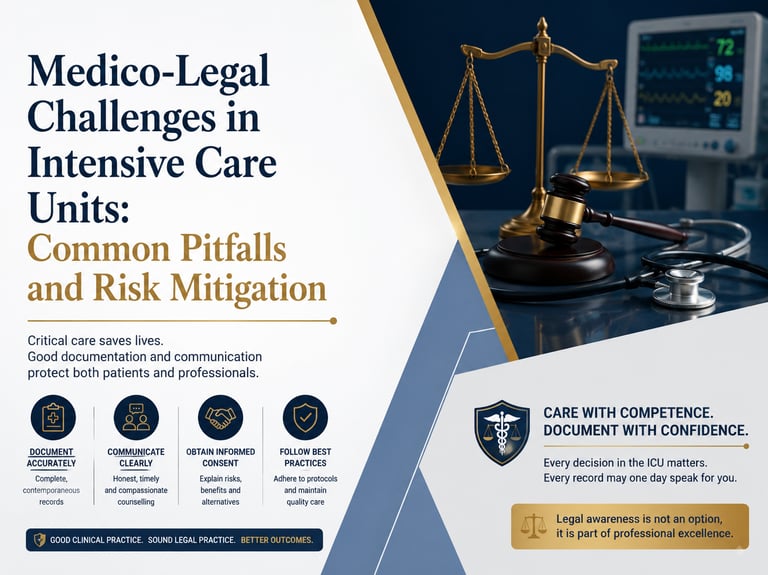
Medico-Legal Challenges in Intensive Care Units: Common Pitfalls and Risk Mitigation
Advocate Pranesh Gupta
Advocate & Legal Consultant
Delhi High Court | District Courts | Tribunals
🌐 www.praneshlegal.com


Introduction
The Intensive Care Unit (ICU) represents one of the most legally sensitive areas of modern healthcare. Every day, intensivists make life-saving decisions under extreme time pressure, often with incomplete information and in emotionally charged circumstances. Patients are critically ill, mortality is high, and families expect the best possible care. When outcomes are unfavourable, dissatisfaction may sometimes result in allegations of medical negligence, criminal complaints, consumer disputes, violence against healthcare professionals, or prolonged litigation.
In India, medico-legal disputes involving intensive care have increased significantly over the past two decades. Several factors have contributed to this trend, including rising public awareness of legal rights, increasing healthcare costs, social media influence, greater scrutiny by regulatory authorities, and easier access to consumer forums and courts.
However, most medico-legal cases against intensivists do not arise solely because a patient dies. Rather, they frequently stem from deficiencies in communication, documentation, informed consent, inadequate record keeping, or misunderstanding between treating doctors and family members.
Understanding these medico-legal risks is therefore as important as understanding mechanical ventilation or vasopressor therapy. Good clinical practice and sound legal practice often go hand in hand.
This article discusses common medico-legal challenges encountered in Indian ICUs and practical strategies to minimise legal risk while maintaining high standards of patient care.
Why Intensive Care is Medico-Legally Vulnerable
Unlike many other specialities, ICU practice involves:
High mortality
Rapid clinical deterioration
Multiple invasive procedures
High-cost treatment
Uncertain prognosis
Decisions regarding life support
Family members under extreme emotional stress
These factors naturally increase the likelihood of disputes.
Courts generally appreciate that ICU medicine involves complex decision-making. Nevertheless, they also expect doctors to exercise reasonable skill, maintain proper records, communicate honestly, and follow accepted standards of care.
Common Medico-Legal Pitfalls
1. Inadequate Documentation
Poor documentation remains the single most common medico-legal weakness in intensive care.
Medical records often become the most important evidence before courts, consumer commissions, or disciplinary authorities.
Common deficiencies include:
Missing progress notes
Absence of daily assessment
Unrecorded discussions with family
Incomplete procedure notes
Illegible handwriting
Missing signatures
Undocumented clinical reasoning
Courts generally consider that if an important clinical event is not documented, it may be difficult to establish that it occurred.
Risk Mitigation
Maintain contemporaneous documentation covering:
Diagnosis
Clinical condition
Differential diagnosis
Treatment rationale
Investigations
Procedures
Response to treatment
Family counselling
Prognosis discussions
Electronic records, where available, should be accurate and regularly reviewed.
2. Informed Consent
Obtaining consent is not merely a signature on a printed form.
True informed consent requires that the patient or legally authorised representative understands:
Nature of illness
Proposed procedure
Expected benefits
Possible risks
Available alternatives
Consequences of refusing treatment
Generic consent forms offer limited protection if meaningful communication has not taken place.
Separate consent should be obtained for major invasive procedures whenever feasible.
3. Communication Failure
Communication breakdown remains one of the leading causes of litigation.
Families generally accept poor outcomes more readily when they believe they were kept informed honestly and respectfully.
Common communication errors include:
Conflicting information from different doctors
Unrealistic assurances
Excessive optimism
Avoiding difficult conversations
Failure to explain prognosis
Poor explanation of financial implications
Best Practice
Provide structured counselling at regular intervals.
Document:
Date
Time
Persons present
Information discussed
Questions asked
Decisions taken
4. Delay in Escalation of Care
Delayed intubation
Delayed referral
Delayed specialist consultation
Delayed transfer
Delayed surgery
All may become subjects of legal scrutiny.
Clinical deterioration should be documented together with the reasons behind management decisions.
5. Medication Errors
Medication errors include:
Wrong drug
Wrong dose
Wrong patient
Wrong route
Wrong infusion rate
Failure to discontinue medication
High-risk drugs include:
Vasopressors
Insulin
Sedatives
Neuromuscular blockers
Anticoagulants
Double-check systems significantly reduce errors.
6. Procedure-Related Complications
Central venous catheter insertion
Arterial cannulation
Tracheostomy
Chest tube insertion
Lumbar puncture
Each carries recognised complications.
A complication alone does not establish negligence.
However, documentation should include:
Indication
Consent
Procedure details
Operator
Complications
Immediate management
7. End-of-Life Decisions
One of the most difficult areas in ICU practice concerns patients with irreversible illness.
Indian law has evolved considerably regarding withholding or withdrawing life-sustaining treatment.
Important principles include:
Respect for patient autonomy
Shared decision-making
Appropriate documentation
Institutional policies
Compliance with prevailing legal guidelines
Every discussion regarding limitation of treatment should be carefully documented.
8. Financial Transparency
Unexpected bills frequently generate conflict.
Families should receive realistic information regarding:
Expected ICU costs
Possible prolonged stay
High-cost drugs
Blood products
Procedures
Transparent communication helps avoid allegations of exploitation.
9. Violence Against Healthcare Professionals
Violence in ICUs remains a serious concern.
Common triggers include:
Unexpected death
Delayed communication
Billing disputes
Perceived negligence
Hospitals should maintain:
Security protocols
CCTV surveillance
Visitor policies
Controlled access
Crisis management plans
Early communication often prevents escalation.
10. Discharge Against Medical Advice (DAMA)
Patients occasionally leave despite medical advice.
Proper documentation should include:
Clinical condition
Risks explained
Consequences discussed
Signature of attendant
Witness
Never refuse emergency stabilisation merely because a patient may subsequently leave.
Documentation: The Doctor's Best Defence
Medical records frequently become the strongest defence in court.
Good records demonstrate:
Appropriate assessment
Rational decision-making
Continuous monitoring
Communication
Compliance with accepted standards
Remember:
Good medicine produces good records.
Good records protect good medicine.
Practical Risk Mitigation Strategies
Every ICU should develop written protocols covering:
Documentation
Daily progress notes
Procedure notes
Consent documentation
Family counselling records
Checklist before discharge
Communication
Designated spokesperson
Daily counselling schedule
Written summaries
Financial counselling
Clinical Governance
Standard Operating Procedures
Checklists
Incident reporting
Mortality review
Clinical audit
Simulation training
Legal Preparedness
Maintain records securely.
Never alter records retrospectively.
Preserve investigation reports.
Respond promptly to medico-legal notices.
Seek legal advice early where appropriate.
Lessons from Litigation
Analysis of medico-legal cases suggests that many disputes arise not because doctors lacked competence, but because they failed to demonstrate that reasonable care had been exercised.
Courts generally evaluate whether:
Accepted medical practice was followed.
Appropriate judgment was exercised.
Records support clinical decisions.
Communication was adequate.
Documentation is consistent.
A well-documented decision supported by accepted medical practice is considerably easier to defend than an undocumented one.
Ten-Point ICU Medico-Legal Checklist
Before ending each ICU shift, ask:
✅ Have all significant events been documented?
✅ Were invasive procedures properly recorded?
✅ Has consent been obtained where required?
✅ Was the family counselled today?
✅ Are prognosis discussions documented?
✅ Have medication changes been recorded?
✅ Are investigation reports filed?
✅ Have unusual events been documented?
✅ Are records signed with date and time?
✅ Would another intensivist understand today's management from the notes alone?
Conclusion
Critical care medicine is one of the most demanding disciplines in healthcare. Intensivists are required to make rapid, complex decisions while balancing medical uncertainty, ethical dilemmas, emotional family interactions, and resource constraints.
Although adverse outcomes cannot always be prevented, many medico-legal disputes can be minimized through meticulous documentation, transparent communication, informed consent, adherence to accepted standards of care, and robust institutional protocols.
Good clinical practice remains the strongest medico-legal safeguard. An intensivist who communicates honestly, documents carefully, follows evidence-based practice, and treats patients with compassion is not only providing better healthcare but also significantly reducing medico-legal risk.
As healthcare delivery becomes increasingly complex, legal awareness should be regarded not as a burden but as an integral component of professional competence. By integrating sound clinical judgment with prudent medico-legal practices, intensivists can protect both their patients and themselves while maintaining public trust in the profession.
Protect Your Practice. Protect Your Future.
Practical Medico-Legal Guidance for Healthcare Professionals, Hospitals, and Medical Institutions.


About the Author
Advocate Pranesh Gupta is an Advocate and Legal Consultant practicing before the Delhi High Court, District Courts, and Tribunals in Delhi NCR. He advises clients on criminal, civil, matrimonial, consumer, property, arbitration, and healthcare-related legal matters. Through the Healthcare Law Resource Centre at www.praneshlegal.com, he aims to promote legal awareness among healthcare professionals and institutions by providing practical guidance on medico-legal issues affecting modern medical practice.